
In The Gravity-Defying Design of the Caracal Cat, narrator Suranne Jones looks at the perfect design of the caracal, a wild cat, that allows it to leap upwards, defying gravity and catching birds in flight. Even more amazing is how the cat uses its flexible spine to twist its body two different ways so that it can push off itself and land on its feet no matter what. This video is excerpted from BBC’s Life in the Air, a documentary about animals that take to the sky.
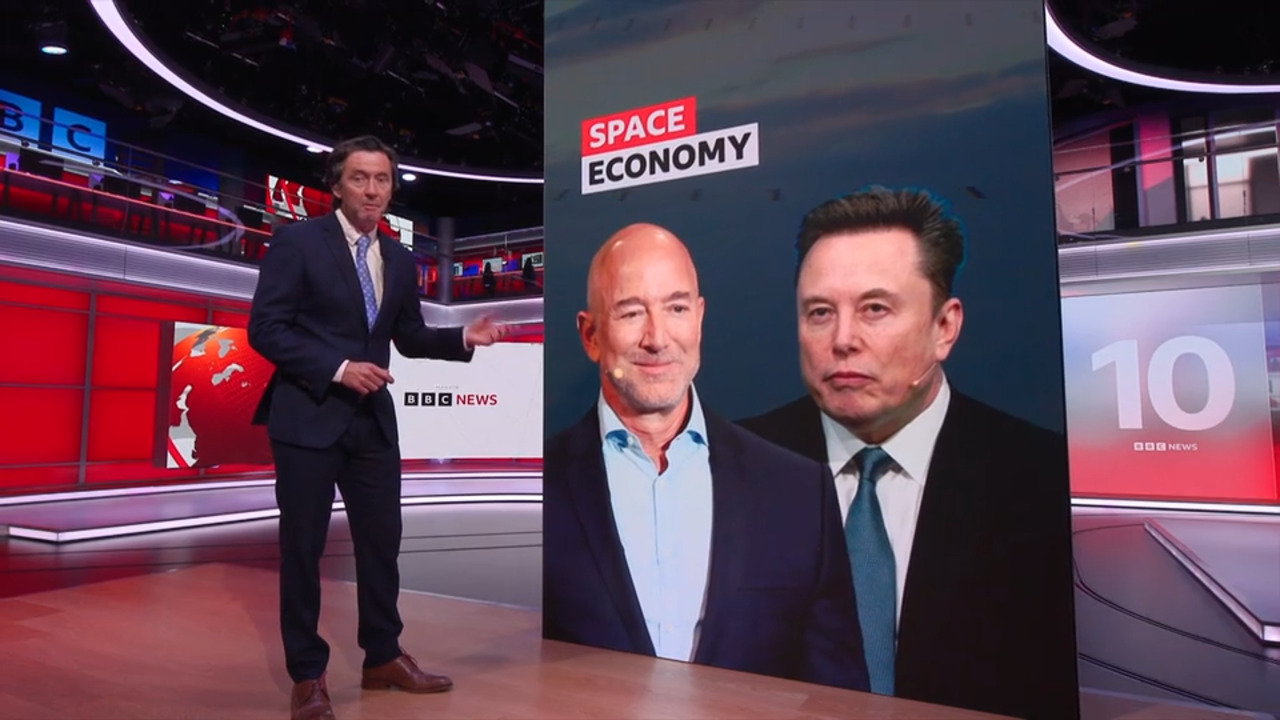
The “global space economy” refers to pretty much everything having to do with human progress through space, including exploration, research, management, and use. It also generates hundreds of billions of dollars every year.
You may not have heard the term “global space economy,” but you’ve probably heard of at least two of the big players: Jeff Bezos and Elon Musk. As founders of Blue Origin and SpaceX, their companies are estimated to be worth $100 billion and $1.8 trillion, respectively. If you took 1.8 trillion standard dollar bills end-to-end, it would stretch 100 million miles — more than the distance from the Earth to the Sun! Imagine walking to the Sun on a bridge made of money! You couldn’t, because of all of the “zero gravity.” Your feet would also get very tired. There’s also no oxygen. But we know all of this because of how much we’ve studied space!
So why spend so much time and money on the space industry, which has expanded massively in the last few decades? Don’t only a few select astronauts go to space? Shouldn’t we be focusing on Earth? Well, what we learn in space has a big impact on what we do on the ground. Our findings from space show up as the GPS on our phones, in ships navigating the oceans, even as farmers using satellite photography to plan their crops.
There’s no sign of slowing down on the space front — the UK is focusing on small satellites, America is hoping to put astronauts back on the moon by 2028, and China is planning its own lunar landing by 2030. These explorations could provide valuable minerals, insight to getting past the Moon (like to Mars), and open up space tourism opportunities.
In The Gravity-Defying Design of the Caracal Cat, narrator Suranne Jones looks at the perfect design of the caracal, a wild cat, that allows it to leap upwards, defying gravity and catching birds in flight. Even more amazing is how the cat uses its flexible spine to twist its body two different ways so that it can push off itself and land on its feet no matter what. This video is excerpted from BBC’s Life in the Air, a documentary about animals that take to the sky.
The “global space economy” refers to pretty much everything having to do with human progress through space, including exploration, research, management, and use. It also generates hundreds of billions of dollars every year.
You may not have heard the term “global space economy,” but you’ve probably heard of at least two of the big players: Jeff Bezos and Elon Musk. As founders of Blue Origin and SpaceX, their companies are estimated to be worth $100 billion and $1.8 trillion, respectively. If you took 1.8 trillion standard dollar bills end-to-end, it would stretch 100 million miles — more than the distance from the Earth to the Sun! Imagine walking to the Sun on a bridge made of money! You couldn’t, because of all of the “zero gravity.” Your feet would also get very tired. There’s also no oxygen. But we know all of this because of how much we’ve studied space!
So why spend so much time and money on the space industry, which has expanded massively in the last few decades? Don’t only a few select astronauts go to space? Shouldn’t we be focusing on Earth? Well, what we learn in space has a big impact on what we do on the ground. Our findings from space show up as the GPS on our phones, in ships navigating the oceans, even as farmers using satellite photography to plan their crops.
There’s no sign of slowing down on the space front — the UK is focusing on small satellites, America is hoping to put astronauts back on the moon by 2028, and China is planning its own lunar landing by 2030. These explorations could provide valuable minerals, insight to getting past the Moon (like to Mars), and open up space tourism opportunities.