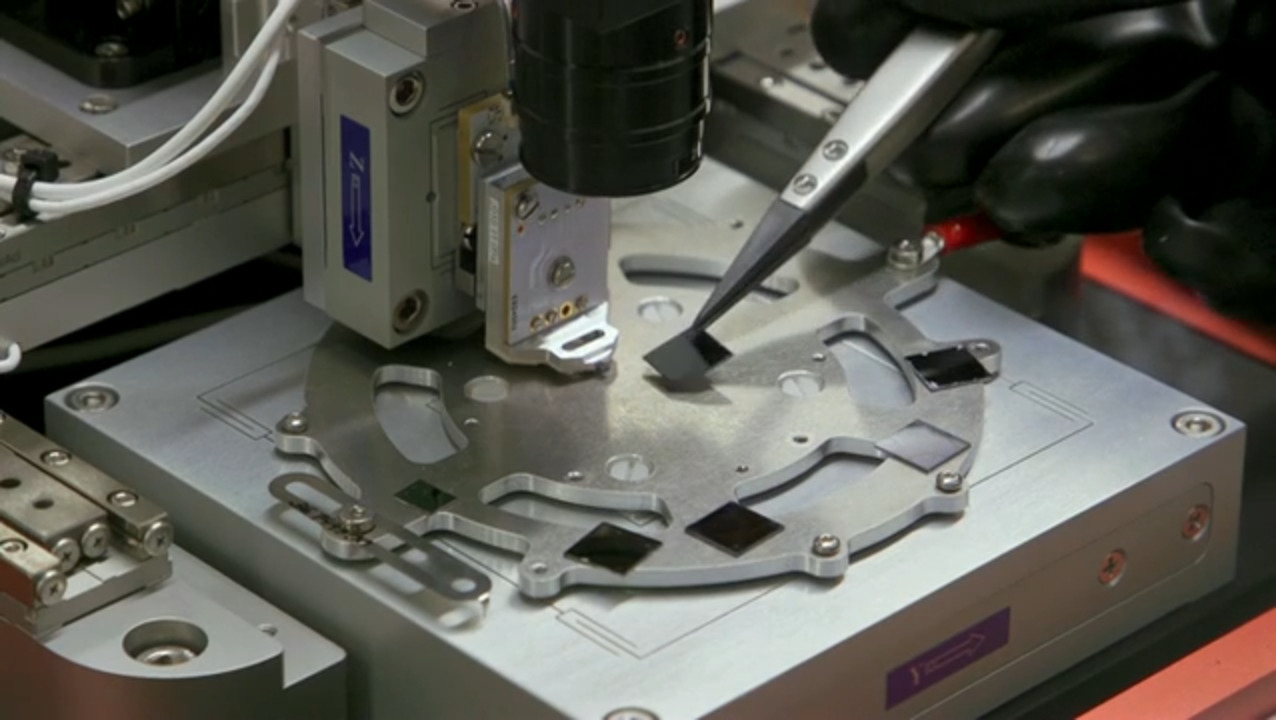
Nanolitho... Nanilitha... Hmm. Ahem. Nanolithography is the process of fabricating, etching, or printing patterns on a material’s surface at the nanometer (one billionth of a meter) scale. It’s OK, we had to look it up, too.
It’s probably not a word you hear in everyday life, but you’re likely familiar with some of the results. You’re probably reading this on one of those results, because it’s a prominent part of building phones and computers — both things that rely on technology that allows manufacturers to pattern incredibly small things. The process is similar to screen printing, where you create a stencil of your design, lay your screen onto your material, pour on the paint, and lift your screen to reveal the design. Nanolithography uses a similar method, but on a much, much, much smaller scale. Way smaller stuff than you’d ever get your pencil sharp enough to sketch!
For example, scientists have created the world’s smallest violin at 13 microns wide and 40 microns tall. To put it in perspective, a micron is 0.000001 m, and one single human hair is between 15 and 120 microns. So you probably can’t play the violin, but it’d be really easy to pack in your bag.
Aside from being cool, learning how to work with material at this teeny tiny scale can open up new possibilities in technology, and is crucial for making improvements.
Nanolitho... Nanilitha... Hmm. Ahem. Nanolithography is the process of fabricating, etching, or printing patterns on a material’s surface at the nanometer (one billionth of a meter) scale. It’s OK, we had to look it up, too.
It’s probably not a word you hear in everyday life, but you’re likely familiar with some of the results. You’re probably reading this on one of those results, because it’s a prominent part of building phones and computers — both things that rely on technology that allows manufacturers to pattern incredibly small things. The process is similar to screen printing, where you create a stencil of your design, lay your screen onto your material, pour on the paint, and lift your screen to reveal the design. Nanolithography uses a similar method, but on a much, much, much smaller scale. Way smaller stuff than you’d ever get your pencil sharp enough to sketch!
For example, scientists have created the world’s smallest violin at 13 microns wide and 40 microns tall. To put it in perspective, a micron is 0.000001 m, and one single human hair is between 15 and 120 microns. So you probably can’t play the violin, but it’d be really easy to pack in your bag.
Aside from being cool, learning how to work with material at this teeny tiny scale can open up new possibilities in technology, and is crucial for making improvements.